
An Indonesian Perspective: A Missing Link
The returns are there, and the capability is exported elsewhere. Why not Indonesia?
Indonesia has, on average, yielded 9.6% on foreign equity from 2015 to 2025, COVID years included. That is roughly double the United States or the United Kingdom, who held 35% of Australia's foreign direct investment (FDI) at the end of 2025. Indonesia held only 0.16% of it.
As we saw in the previous post of this series, returns did not explain this gap.
The next candidate is capability. Perhaps Australians simply do not do the things Indonesia needs?
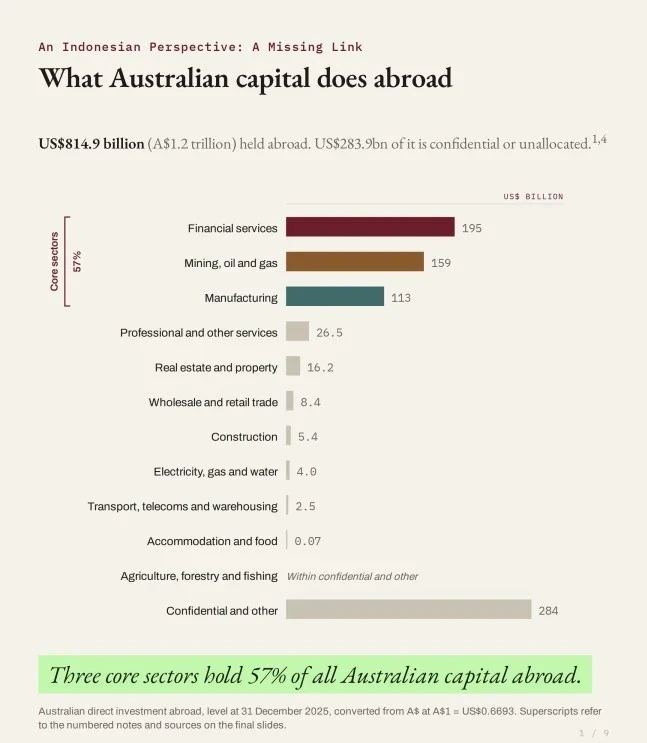
Let's start with the verticals Australian FDI is comfortable and willing to invest in. Out of US$815 billion (A$1.2 trillion) held abroad, three core sectors account for 57%:
- Financial servicesUS$195 billion (23.9%)
- Mining, oil and gasUS$159 billion (19.6%)
- ManufacturingUS$113 billion (13.9%)
Australia runs these at scale at home and has expanded them into global operations across its major markets. Now look at the same three in Indonesia:
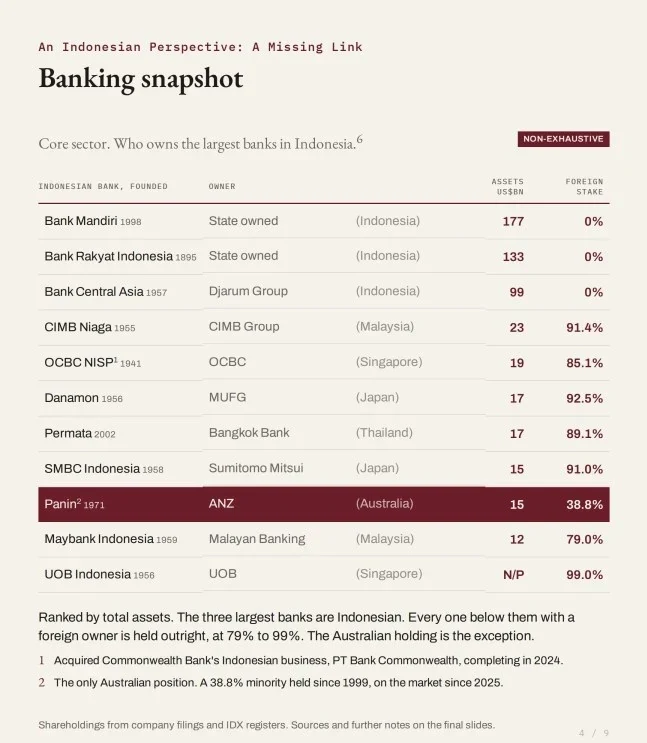
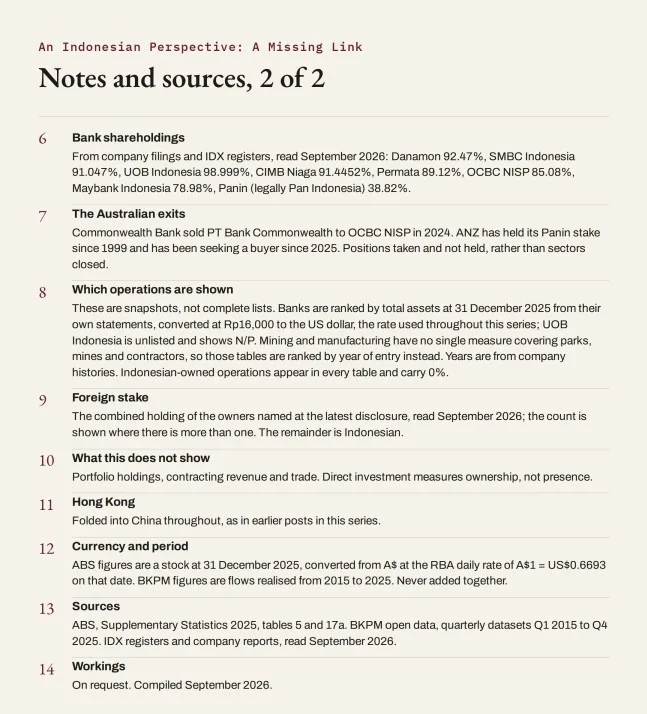
Financial services (banking): The six largest banks are Indonesian. Every middle tier bank below them is outright foreign-owned, at 79% to 99%: MUFG, Sumitomo Mitsui, UOB, CIMB, Bangkok Bank, OCBC, Maybank. Australia's position is ANZ's 38.8% of Panin, ninth by assets, held since 1999, for sale since 2025.
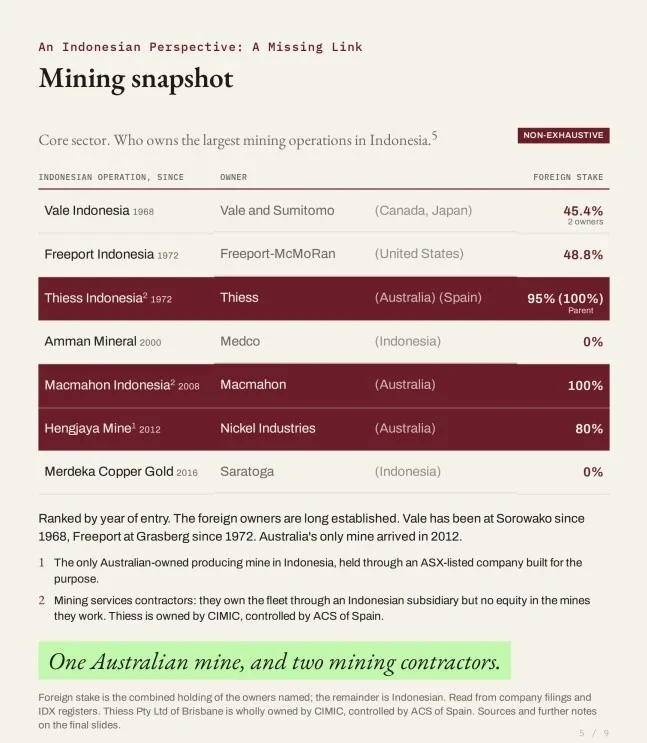
Mining: Vale has been at Sorowako in South Sulawesi since 1968, Freeport at Grasberg in Central Papua since 1972. Australia owns a major stake in one nickel mine, Hengjaya in Central Sulawesi, since 2012. Its other two names, Macmahon and Thiess, are contractors. They are the experts you bring in to mine, not the mine operator.
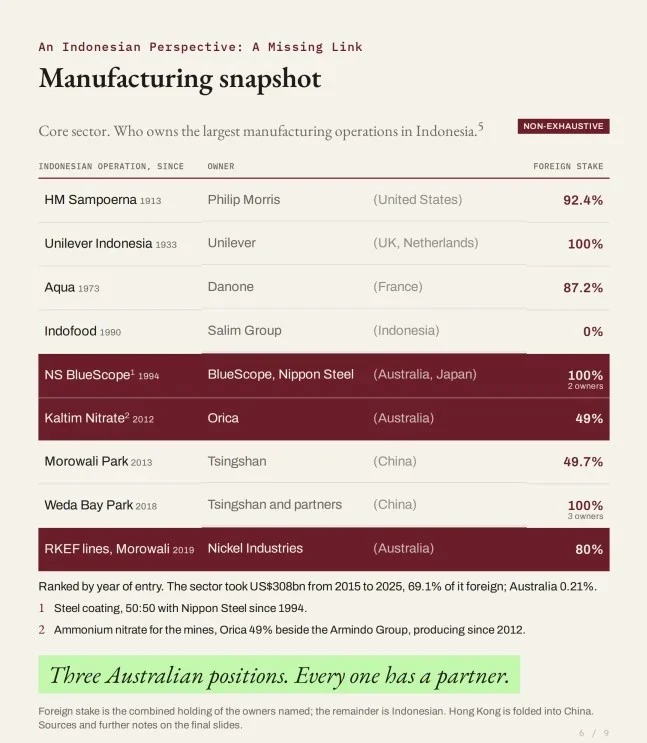
Manufacturing: Sampoerna since 1913, Unilever since 1933, Aqua since 1973, the Chinese nickel parks since 2013. Australia has three positions, each beside a partner: BlueScope with Nippon Steel, Orica with Armindo, and Nickel Industries within a Chinese operated enclave run by Tsingshan.
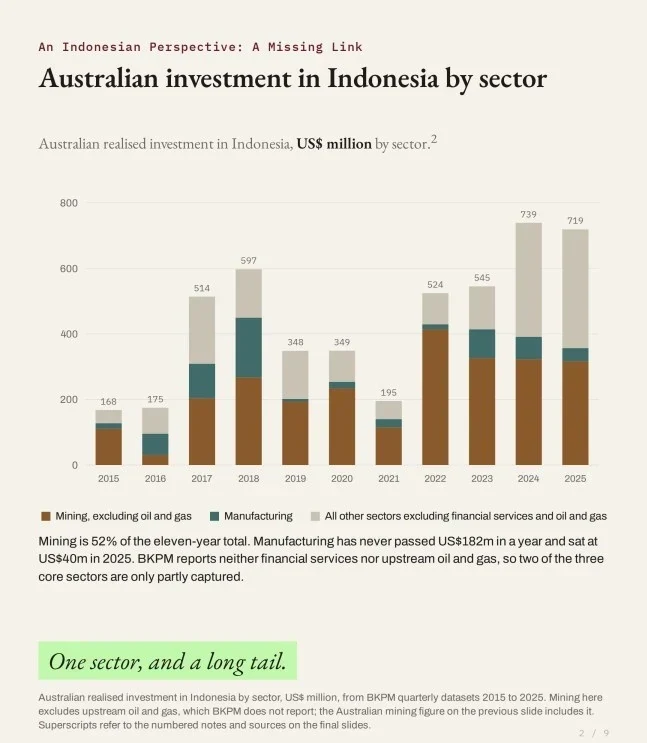
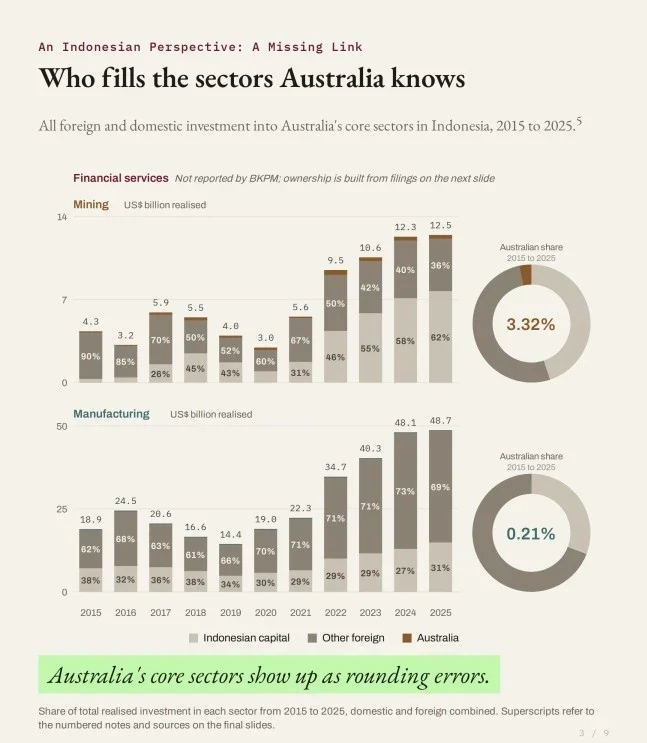
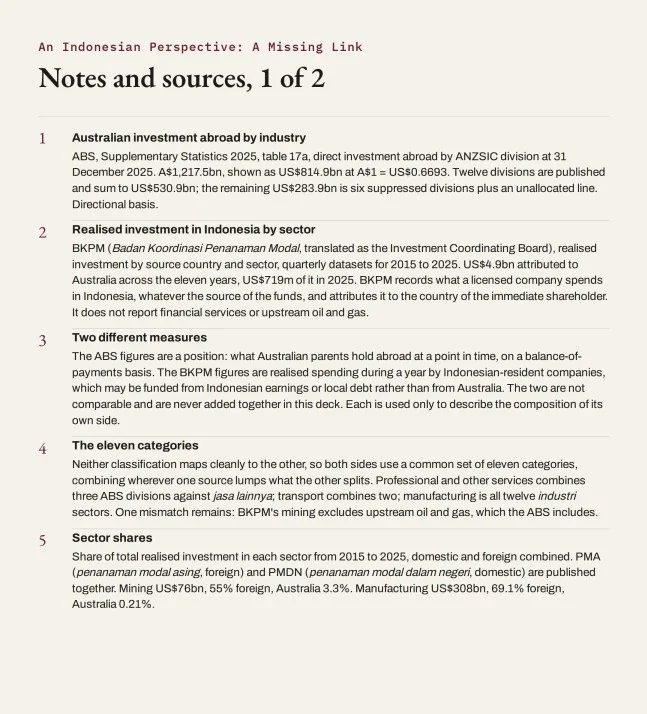
On realised investment data from BKPM (Badan Koordinasi Penanaman Modal, translated as the Investment Coordinating Board), Australia flowed US$4.9 billion into Indonesia across eleven years. Mining was 52% of it. As a share of total flows, foreign and domestic, Australia provided 3.3% of mining and 0.21% of manufacturing.
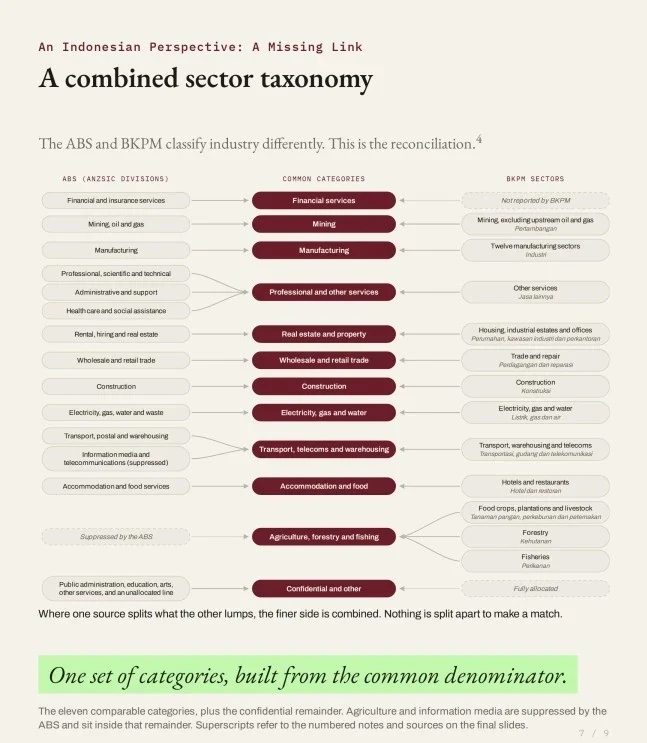
Three caveats. The two countries classify industry differently, so a judgement call has been used in their alignment. BKPM reports neither financial services nor upstream oil and gas, so banking is built from company filings.
But across the cross-border data, the bigger question remains: the returns are there, and the capability is exported elsewhere. Why not Indonesia?
Exhibits
Swipe or use the arrows. Select an exhibit to open it full size.